Performance Assessment · For Executives, Professionals & Athletes
Where your sport lives on the force-velocity continuum. What training actually moves the needle. And how to tell the difference.
16-year-old semi-pro soccer player. From knee pain to an 85 kg front squat for reps, pain-free, in six months.

The Framework
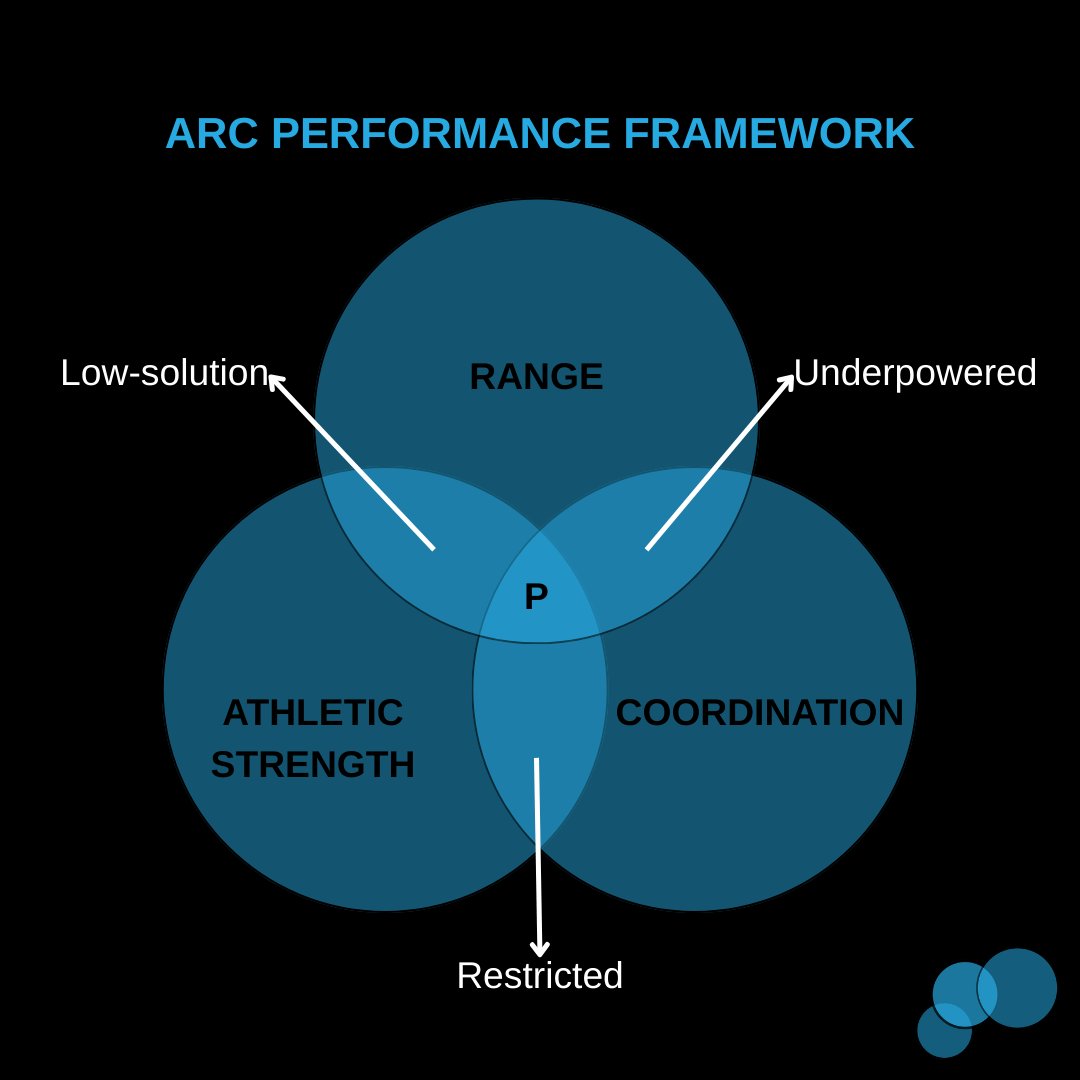
Performance does not come from one quality. It emerges when athletic strength, range, and coordination coexist. Most athletes are missing qualities. Find and train the missing piece.
A
Athletic Strength
Be strong, fast, explosive, powerful, adaptable.
Without it: underpowered athlete
R
Range
Own positions with adequate mobility and stability.
Without it: restricted athlete
C
Coordination
Have multiple movement solutions ready to solve the problems sport throws at you.
Without it: low-solution athlete
Force, Velocity, Time
Every athletic task is a time-constrained force problem. The faster the movement, the less time to apply force, and the different the strategy your body needs. The curve below maps where each sport lives.
The Assessment
Answer all four questions based on what happens in competition, not in the gym. The region that appears most often is your primary.
Question 01
Question 02
Question 03
Question 04
The region that appears most often is your primary. The adjacent region matters too, but the primary sets the training emphasis.
Free Guide
The 10-page ARC Performance Assessment ebook. Everything above, plus the full force-velocity continuum breakdown, the region cross-reference, and the four primary session templates I use with every athletic client. Delivered to your inbox.
What's Next
Knowing the target is step one. Mapping your current qualities against it is the next layer. That's what I do with every athletic client: we turn this framework into a training plan built around your gap, not a generic template.